Here is a video made from Hubble images of the star Monocrotis V838.
http://www.cnn.com/video/data/2.0/video/tech/2014/06/13/orig-jag-nasa-hubble-timelapse.cnn.html
This star was discovered about 12 years ago. It was immediately recognized as a "variable star", a star whose brightness changes over time. The Hubble telescope made regular observations of Monocrotis V838 over the next 4 years. It has brightened, then dimmed, then brightened again. The pattern of brightening and dimming is unlike any other variable star observed to date. At its brightest, it was one of the brightest stars in our galaxy (in absolute terms). Read this Wikipedia article for more details....
http://en.wikipedia.org/wiki/V838_Monocerotis
Saturday, June 21, 2014

LOWBROW MEMBER’S IMAGES APPEARING IN LOCAL SHOW
LOWBROW MEMBER’S IMAGES APPEARING IN LOCAL SHOW
Perhaps Lowbrows remember an email that was received from “The Gallery Project” a few months ago. They were looking for images for the upcoming “Unseen” show. Brian Ottum responded and they have selected a few of his shots to include in the show. Their explanation of the theme:
“The quest to see lies at the heart of human urgency. To breach the barrier between the visible and the invisible is compelling, emotional, informative and even magical. This process of discovery has always driven thinkers and image makers: artists, scientists and philosophers, from astronomers to nanotechnologists, from documentarians and data analysts to planners and prognosticators. As the unseen becomes seeable and seen, a pivot occurs, revealing and demanding irreversible change. No one who has seen is ever the same.”
The show will be in Detroit’s Eastern Market for the month of August, then move to the Ann Arbor Art Gallery September 12 to October 12.
See The Gallery Project’s website for more information:
http://www.thegalleryproject.com/
Here are Brian’s subjects and why they fit with the theme: Rosette Nebula has Bok Globules where stars form within an opaque cocoon. Bryce Canyon rock spire points to the center of the Milky Way galaxy, where a supermassive black hole is invisible behind stars, gas and dust. Rho Ophiuchus region has large dark rivers of dust clouds that hide objects behind. Finally, the Orion Nebula is both a stellar nursery and also contains three mysterious straight lines – geosynchronous satellites.
Perhaps Lowbrows remember an email that was received from “The Gallery Project” a few months ago. They were looking for images for the upcoming “Unseen” show. Brian Ottum responded and they have selected a few of his shots to include in the show. Their explanation of the theme:
“The quest to see lies at the heart of human urgency. To breach the barrier between the visible and the invisible is compelling, emotional, informative and even magical. This process of discovery has always driven thinkers and image makers: artists, scientists and philosophers, from astronomers to nanotechnologists, from documentarians and data analysts to planners and prognosticators. As the unseen becomes seeable and seen, a pivot occurs, revealing and demanding irreversible change. No one who has seen is ever the same.”
The show will be in Detroit’s Eastern Market for the month of August, then move to the Ann Arbor Art Gallery September 12 to October 12.
See The Gallery Project’s website for more information:
http://www.thegalleryproject.com/
Here are Brian’s subjects and why they fit with the theme: Rosette Nebula has Bok Globules where stars form within an opaque cocoon. Bryce Canyon rock spire points to the center of the Milky Way galaxy, where a supermassive black hole is invisible behind stars, gas and dust. Rho Ophiuchus region has large dark rivers of dust clouds that hide objects behind. Finally, the Orion Nebula is both a stellar nursery and also contains three mysterious straight lines – geosynchronous satellites.
Thursday, May 15, 2014
The Camelopardalids Meteor Shower
There is a new meteor shower (called the Camelopardalids), that is expected to peak the evening of May 23 and the morning of May 24. Because it is new, no one is 100% certain how it will be behave. Or even if it exists at all.
If the predictions are correct, observers in southern Canada and the continental United States are best positioned to see the shower. The predictions may be wrong; even if you live somewhere else it is worth taking a look. Meteor showers are easy to observe, all you need is clear skies, a little patience and of course meteors.
For more information see
http://earthsky.org/space/comet-209p-linear-meteor-shower-storm-may-2014
If the predictions are correct, observers in southern Canada and the continental United States are best positioned to see the shower. The predictions may be wrong; even if you live somewhere else it is worth taking a look. Meteor showers are easy to observe, all you need is clear skies, a little patience and of course meteors.
For more information see
http://earthsky.org/space/comet-209p-linear-meteor-shower-storm-may-2014
Earth from the International Space Station
You can watch the earth from cameras recently installed on the ISS (International Space Station).
http://www.ustream.tv/channel/iss-hdev-payload
Please note, you may see a grey screen or a black screen. When the ISS is on the night side of the earth, you get a black screen. A grey screen indicates they are switching cameras or there is a technical difficulty.
http://www.ustream.tv/channel/iss-hdev-payload
Please note, you may see a grey screen or a black screen. When the ISS is on the night side of the earth, you get a black screen. A grey screen indicates they are switching cameras or there is a technical difficulty.
Tuesday, April 29, 2014
First Light of the 17 inch
The following message came from our club president...


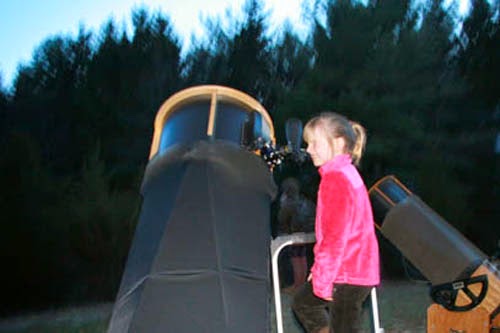
As you noted from the images Mike Radwick (thank you Mike) sent to us, "official" first light for our club's new telescope has occurred! (See yesterday's post for more about the telescope, see below for the images). It was pretty much a complete success. We need to add a little weight to the mirror end and digital setting circles remain to be installed. Setup and collimation went fine and the mirror seemed to cool down quickly. The images were very good. Excellent detail and resolution of Jupiter and Mars. Porrima was a very clean split. Not that big a deal at about 2.2 arc seconds, but we used low power. M35 showed pinpoint stars to the edge of the field of a 26mm Nagler. The supernovae in M82 was easier to detect than it was in the McMath. Everyone that touched this scope, from the re-figuring of the mirror to the finished product should be thanked thoroughly for their excellent work! This is going to be a great club resource.And the photos from Saturday night...
Our new scope has already done great service as we had a turnout of at least a dozen Lowbrows and a public turnout of 60 to 75. It may have started a little later than we hoped, but the season has started in grand style. We should be proud.
The telescope with one pair of truss tubes.
Some of the components...
Setting it up...
Carly takes a look...
Monday, April 28, 2014
The Club's new telescope
A long time ago (no one seems willing to admit, or remember, how long) there was a proposal to allow the ATM group (amateur telescope making group) group to rebuild the club’s Coulter telescope. This telescope was a large Dob sitting in the observatory building, unused.
The idea: rebuild the telescope so it would be more usable. The mirrors would be used in a newly constructed telescope. The proposal passed, but progress was slow. That is until the autumn months of 2013, when a Telekit was ordered. The ATM group started meeting once a week, to assemble the kit. There were many tasks that needed to be coordinated among the group, such as sending the mirror to be recoated. It took time, but there was steady progress.
The most recent of the ATM meetings was last Saturday. While there were some mirror issues that remain (not to mention the possible addition of electronics, which would be yet another project), the end result was a usable telescope.
The telescope was brought to the Saturday open house. It was performing well, and Lowbrows as well as club visitors had the chance to look through it. There were some photographs taken at the open house and I plan to post some of them later this week.
For information about open houses at Peach Mountain (located a few miles from Dexter, Michigan) see http://www.umich.edu/~lowbrows/calendar/regular.html
For a schedule of astronomy events in Southeast Michigan (including open houses at Peach Mountain) see http://www.umich.edu/~lowbrows/calendar/
The telescope was brought to the Saturday open house. It was performing well, and Lowbrows as well as club visitors had the chance to look through it. There were some photographs taken at the open house and I plan to post some of them later this week.
For information about open houses at Peach Mountain (located a few miles from Dexter, Michigan) see http://www.umich.edu/~lowbrows/calendar/regular.html
For a schedule of astronomy events in Southeast Michigan (including open houses at Peach Mountain) see http://www.umich.edu/~lowbrows/calendar/
Tuesday, April 15, 2014
Lunar Eclipse Photos
It was overcast in Southeast Michigan (in fact it snowed, two inches in Ann Arbor, possibly enough to make 2013/2014 the snowiest season in Ann Arbor history). So we couldn't see the lunar eclipse here.
However it wasn't overcast everywhere. Brian Ottum was able to get some photos from a telescope located in New Mexico that he controlled remotely from Michigan. He posted his photos on flickr...
http://www.flickr.com/photos/
However it wasn't overcast everywhere. Brian Ottum was able to get some photos from a telescope located in New Mexico that he controlled remotely from Michigan. He posted his photos on flickr...
http://www.flickr.com/photos/
Subscribe to:
Posts (Atom)